
Jiangsu Easywell Smart Products Co., Ltd. presents a high-performance range of in-line manifolds, engineered to optimize fluid distribution in industrial, commercial, and HVAC systems.
As a compact extension of Easywell’s hydronic control solutions, these manifolds — including premium carbon steel and durable steel models — are designed to deliver precise flow control, pressure balance, and seamless integration with various heating, cooling, and water circulation systems.
These in-line manifolds are the perfect solution for retrofit projects, wall-mounted boilers, modular HVAC systems, or tight mechanical rooms where space and performance matter most.
Crafted from high-grade carbon steel, stainless steel, or brass, Easywell’s in-line manifolds ensure exceptional durability, corrosion resistance, and flow stability.
Each manifold undergoes precision machining to provide smooth internal flow paths, minimizing turbulence and improving energy efficiency.
| Material | Key Features | Typical Application |
|---|---|---|
| Carbon Steel | Heavy-duty design, pressure-resistant, corrosion-treated finish | Industrial boilers, district heating, high-flow HVAC systems |
| Steel (Standard) | Cost-effective, reliable performance, quick installation | Commercial and residential heating systems |
| Stainless Steel | Maximum corrosion resistance, hygienic surface | Marine, food processing, and humid environments |
Carbon steel manifolds deliver superior performance in demanding applications,
while standard steel models are ideal for general HVAC or plumbing installations.
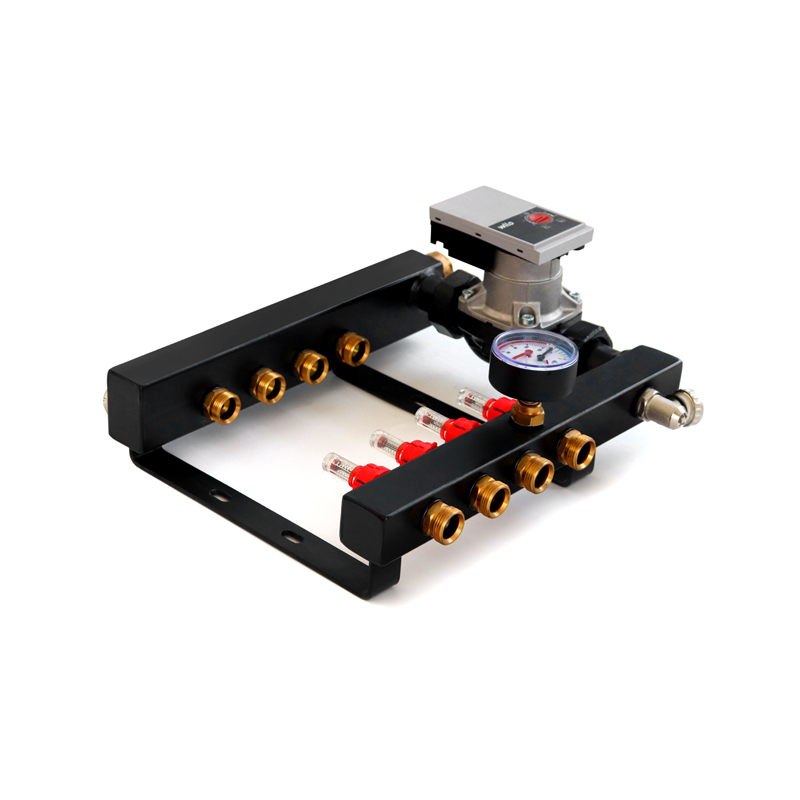
The first image shows the fully assembled in-line manifold, equipped with flow meters, pressure gauge, and control valves.
This configuration demonstrates how the manifold connects to both supply and return lines within hydronic heating or cooling systems.
Key features visible include:
Integrated flow control units with visual flow indicators.
Central pressure gauge for quick system diagnostics.
Compact rectangular frame for wall or cabinet installation.
Brass fittings and valve ports designed for precise sealing and easy maintenance.
This image helps users visualize real-world installation — ideal for highlighting “turnkey system compatibility.”
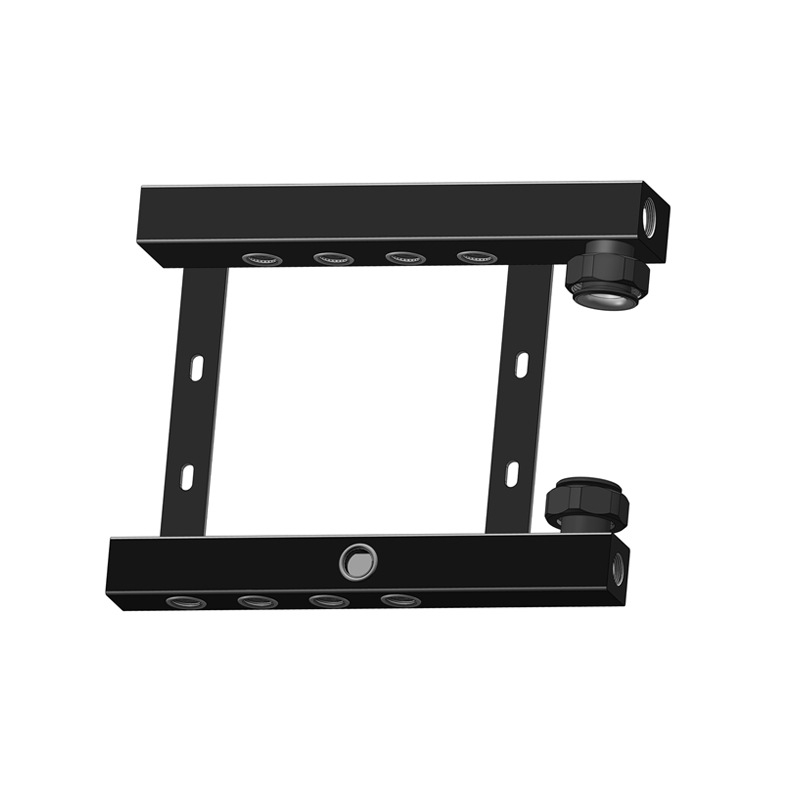
The second image provides a top-down technical view, clearly displaying:
Evenly spaced outlet ports for multi-circuit connections.
Threaded joints (BSP/NPT) allowing flexible piping integration.
Horizontal balance design, ensuring equal flow distribution.
Mounting holes on both sides of the frame for custom positioning during installation.
Perfect for showcasing precision engineering, balanced flow geometry, and structural symmetry.
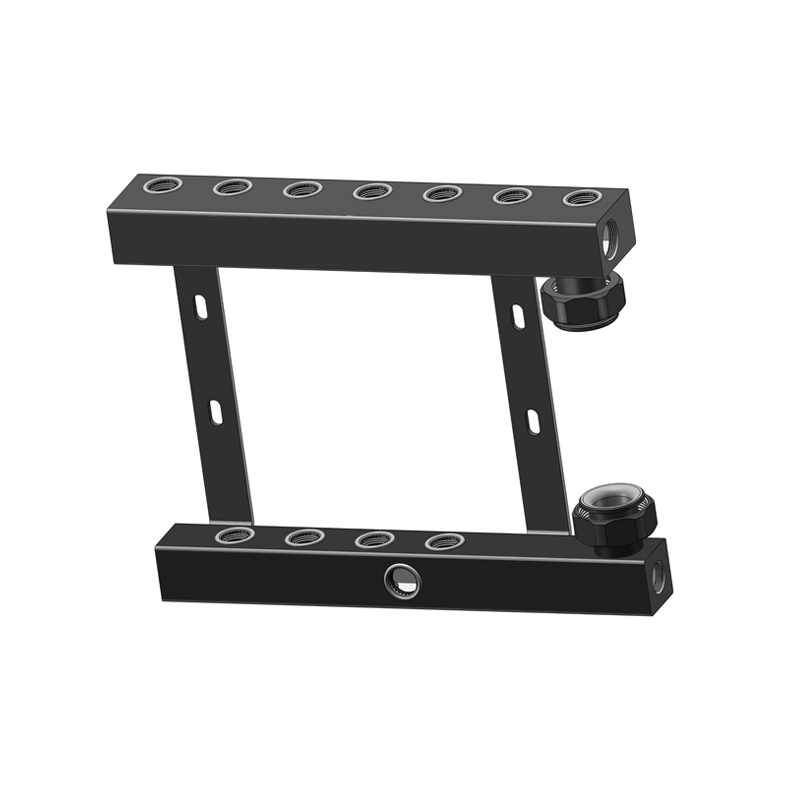
The third image highlights the sturdy side brackets and parallel manifold arrangement, emphasizing:
Reinforced dual-bar structure for stable wall support.
Pre-drilled slots for adjustable installation height.
Compact vertical spacing that minimizes system footprint.
Optional configurations for 2–8 circuits adaptable to various HVAC capacities.
⚙️ This perspective is ideal for explaining space-saving benefits and ease of installation in tight mechanical spaces.
Unlike traditional manifolds, in-line manifolds feature a streamlined, linear structure that integrates directly into piping systems, minimizing installation space while maximizing flow balance.
Slim, compact form factor for wall or cabinet installations
Threaded BSP/NPT or flanged connections for universal compatibility
Pre-assembled kits available to reduce installation time
Balanced flow design to ensure equal pressure distribution across circuits
Operating temperature up to 110°C for hydronic heating or cooling systems
Perfect for modular systems, retrofits, or wall-mounted boilers, where compactness and precision are key.
| Application Scenario | Why It’s Ideal |
|---|---|
| Tight mechanical rooms | Fits behind panels or inside cabinets, saving valuable space. |
| Retrofit projects | Easily integrates with existing systems without major re-piping. |
| Wall-mounted boilers or heat pumps | Aligns directly with outlets and inlets, minimizing leaks. |
| Modular systems or prefabricated units | Simplifies assembly and reduces installation time. |
| Energy-efficient buildings | Supports precise flow control for multi-zone heating and cooling. |
Compact, precise, and installation-friendly — built for modern HVAC and hydronic designs.
| Feature | In-Line Manifold | Standard Manifold |
|---|---|---|
| Design | Linear and slim for tight layouts | Bulkier rectangular design |
| Installation | Wall/cabinet mount, fewer fittings | Requires larger floor space |
| Maintenance | Easy front access | Hard to reach once installed |
| Flow Balancing | Built-in per-circuit control | External valves often required |
| System Integration | Fully compatible with Easywell brackets and consoles | Limited compatibility |
✅ Summary: In-line manifolds are smaller, cleaner, and faster to install, offering a superior solution for modern compact systems and energy-saving upgrades.
A standout advantage of Easywell’s in-line manifolds is their seamless compatibility with other Easywell components:
Expansion Tank Brackets
Expansion Vessel Brackets
Expansion Tank Consoles
Together, they form a cohesive support framework that improves stability, alignment, and installation speed — ideal for complex HVAC configurations or tight retrofits.
| Specification | Description |
|---|---|
| Available Circuits | 2–8 loops |
| Connection Size | ¾″ – 1″ BSP/NPT |
| Working Pressure | Up to 10 bar |
| Operating Temperature | –10°C ~ +110°C |
| Material Options | Carbon Steel, Stainless Steel, Brass |
| Mounting | Wall or cabinet mount |
| Optional Components | Flow meters, balancing valves, air vents, pressure gauges |
Step 1. Preparation
Check all ports for debris or thread damage.
Confirm circuit count and pipe diameter with the system design.
Step 2. Mounting
Secure the manifold horizontally with M8–M10 anchors.
Ensure level positioning for even pressure distribution.
Step 3. Connection
Apply PTFE tape or anaerobic sealant to all threads.
Tighten fittings without over-torquing; use wrench support.
Step 4. Pressure Test
Test at 1.5× working pressure for at least 30 minutes.
Inspect all joints for leaks.
Step 5. Balancing
Open each circuit valve halfway; fine-tune using flow meters after filling the system.
1️⃣ Determine Flow & Circuit Requirements
– Identify how many branches or loops you need (typically 2–8).
2️⃣ Define Your Application
– Heating → carbon steel or stainless steel.
– Cooling → stainless or brass for anti-condensation performance.
3️⃣ Assess Installation Space
– Choose in-line manifolds for wall or cabinet layouts.
4️⃣ Material Selection
– Stainless for corrosion resistance, carbon steel for strength, brass for small systems.
5️⃣ Integration Level
– Select pre-assembled kits for faster installation.
Easywell engineers can help you configure a tailored manifold solution to match your hydronic system design.
| Issue | Cause | Solution |
|---|---|---|
| Uneven flow between loops | Air trapped in circuit | Bleed system through vent ports |
| Pressure drop | Leaking joint or improper seal | Retighten or reseal connections |
| Noise or vibration | Flow imbalance | Adjust flow meters or balancing valves |
| Corrosion signs | Poor water quality | Flush system and add corrosion inhibitor |
| Reduced efficiency | Scale buildup | Perform cleaning annually |
Easywell’s compact in-line manifolds contribute to sustainable, energy-efficient building systems by:
Reducing pump energy consumption via balanced flow.
Lowering leak risk through fewer fittings and joints.
Supporting solar, geothermal, and hybrid heating/cooling systems.
Enabling zone-level temperature control for smarter energy management.
♻️ Compact design, big impact – improving both performance and sustainability.
Residential heating and cooling systems.
Commercial multi-zone HVAC networks.
Industrial process water and circulation loops.
Prefabricated modular systems.
Renewable energy system integration.
Over 20 years of hydronic component manufacturing experience.
ISO-certified facilities with precision CNC processing.
OEM & ODM customization for global partners.
Proven compatibility with Easywell expansion components.
Trusted performance across heating, cooling, and plumbing applications.
It’s compact, linear, and mounts directly into the flow path, saving space and installation time.
Yes. They’re rated for both heating and cooling from –10°C to +110°C.
Yes. They integrate seamlessly with Easywell expansion tank brackets and consoles.
Choose stainless steel or epoxy-coated carbon steel for superior corrosion resistance.
Yes. Pre-assembled kits with gauges, valves, and brackets are available for quick installation.


